8
Chapter 8 · Names Through Differentiation
“In the forward pass, you eliminate information. In the backward pass, you guess.”
Combinations · Automatic differentiation and the pullback
The last chapter ended with index arithmetic — oh + kh in the forward pass became ih - kh in the backward pass. It was the Inversion Rule, applied to coordinates that carry arithmetic.
You’ve been computing gradients all week. loss.backward() handles them. You don’t think about them. Then you write a custom backward pass — a torch.autograd.Function or a manual gradient check — and suddenly you’re staring at a sum over the wrong axis, wondering which coordinate you missed.
The autograd engine computes gradients by tracing the forward pass and inverting each operation. When you write the backward pass by hand, you are the engine. And the engine’s hardest question is: over which coordinates do I sum?
The answer is always the same. It’s the Inversion Rule from Chapter 2, applied to every operation in the forward graph: forward broadcast becomes backward reduction, forward reduction becomes backward broadcast. This chapter shows that the five-step pullback — the procedure for deriving any gradient by hand — is coordinate set subtraction, applied in reverse.
The Shopping Cart and the Restocking Run
An intuition model:
You are writing the backward pass for a custom layer. The forward code is in front of you:
let C[i, j] = sum[k](A[i, k] * B[k, j]);
You have dC[i, j]—the gradient of the loss with respect to C. You need dA[i, k]. You don’t want to look up the formula. You don’t want to memorize the transpose rule. You just want to derive it from what the forward code says.
Start from first principles. A[i, k] appears exactly where? Inside the sum[k]: it is multiplied by B[k, j] and then summed over k. For a specific element A[i0, k0], which output cells does it contribute to? Every output cell where i = i0 AND the sum includes k = k0. That means C[i0, j] for all j.
So A[i0, k0] sends a contribution A[i0, k0] * B[k0, j] to C[i0, j]. The gradient signal dC[i0, j] must flow back along that same path. The local derivative of A[i, k] * B[k, j] with respect to A[i, k] is B[k, j]. So the contribution from output cell C[i0, j] back to A[i0, k0] is dC[i0, j] * B[k0, j].
Now sum over all the output cells that received a contribution. Those are all j positions. The coordinate j is in C but NOT in A. Sum over it:
let dA[i, k] = sum[j](dC[i, j] * B[k, j]);
You just derived the matmul pullback. You didn’t memorize it. You didn’t look it up. You did coordinate accounting: which coordinates does the output have that the operand doesn’t? Sum over those.
What just happened: tracing which coordinates were “paths” from A to C. The coordinate j was a path—every output position along j received input from A[i0, k0]. To send the gradient back, you had to sum over that path. The coordinate k was consumed by the forward sum—it existed in A and was eliminated. The backward pass doesn’t need to sum over k because A[i, k] only contributed to C[i, j] through the specific k value in the sum. Each k position’s gradient is independent.
Here is the pattern. In the forward pass, some coordinates are consumed—a reduction (sum[k]) eliminates them. Some coordinates are silent—a broadcast copies a value along them without the value depending on them. In the backward pass, every consumption becomes a broadcast (the gradient must be spread back over what was consumed) and every silence becomes a reduction (all the copies must be collected).
The forward pass is shopping; the backward pass is restocking the same receipt in reverse.
The Gradient as Coordinate Subtraction
The general rule:
@loss / @W has the same shape as W. The coordinates on the gradient result are exactly the coordinates on the denominator.
Apply this to matrix multiplication. Here is C[i,j] = sum[k](A[i,k] * B[k,j]) and its gradient, forward and backward, side by side:
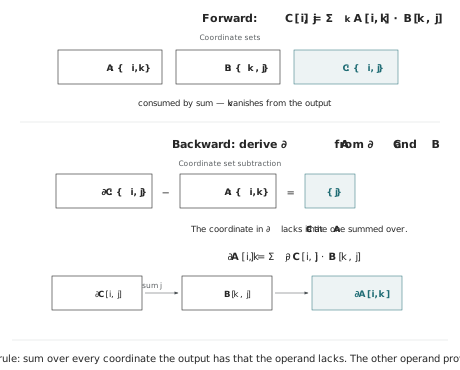
On the left, sum[k] consumes k in the forward pass. On the right, the gradient dA[i,k] sums over j — the coordinate in C that is not in A. The figure reads the same in both directions: forward consumption becomes backward broadcast, forward broadcast becomes backward reduction.
The pullback rule in one sentence: the gradient sums over the set-difference of coordinates between the output and the operand. Output has {i, j}. Operand A has {i, k}. Difference: {j}. Sum over j. The missing coordinate k is provided by the other operand B[k, j].
Coordinate accounting. No transpose rules. No memorization.
The Five-Step Pullback Procedure
Before reading the procedure, try it yourself. Forward: C[i, j] = sum[k](A[i, k] * B[k, j]). You have dC[i, j] — the gradient of the loss with respect to C. You want dA[i, k]. Which output cells does A[i0, k0] contribute to? What’s the local derivative? Which coordinate must you sum over?
Given a forward expression and a target operand, derive the gradient:
- Hold one cell of the target operand. Choose a specific element—say
A[i0, k0]. - List every output cell that reads it. For
C[i, j] = sum[k](A[i, k] * B[k, j]), the held cell is read by every output wherei = i0and the sum includesk = k0. That meansC[i0, j]for allj. - Attach the incoming gradient. Each output cell
C[i0, j]carries a gradient signaldC[i0, j]. The contribution from the path throughA[i0, k0]isdC[i0, j] * B[k0, j]. - Multiply by the local derivative. For elementwise multiplication inside the sum, the local derivative of
A[i, k] * B[k, j]with respect toA[i, k]isB[k, j]. - Sum the routes. The path coordinate—the coordinate in
Cbut not inA—isj. Sum over it.
Path coordinate. A coordinate is a path coordinate for an operand if it appears in the output of a forward computation but does not appear in that operand’s index pattern. The gradient with respect to that operand sums over all of its path coordinates. Formally:
paths(operand, output) = {coordinates in output} \ {coordinates in operand}.
The result: dA[i, k] = sum[j](dC[i, j] * B[k, j]). No calculus memorization. No transpose rules. Just coordinate accounting.
The Pullback in One Example
Observe the five steps on a broadcast-add. Forward:
let out[i, j] = A[i, j] + bias[j];
Given d_out[i, j], find d_bias[j]. What coordinates does the output have? {i, j}. What coordinates does bias have? {j}. The path coordinate (in output but not in bias) is {i}. Sum over {i}.
- Hold one cell:
bias[j0]. - Every output cell reads it:
out[i, j0]for alli. The heldj0value is copied to everyiposition. - Attach the incoming gradient: each output cell carries
d_out[i, j0]. The contribution from the path throughbias[j0]isd_out[i, j0] * 1(the local derivative ofx + biaswrtbiasis 1). - Local derivative: 1.
- Sum over the path coordinates: output has
{i, j}, bias has{j}. Difference:{i}. Sum overi.
Result: d_bias[j] = sum[i](d_out[i, j]). The broadcast coordinate i becomes the reduction coordinate. The Inversion Rule, mechanically applied.
Verify with coordinate set subtraction alone. Forward: out[i, j] = A[i, j] + bias[j]. out has {i, j}, bias has {j}. Set difference: {i}. Sum over {i}. d_bias[j] = sum[i](d_out[i, j]).
The pattern: the gradient sums over whatever is in the output but not in the operand. Five steps. No calculus memorization. The coordinate sets tell you what to sum over. The forward expression tells you what to multiply by.
Convolution Gradients
A convolution is a sum of products with index arithmetic:
let conv[b, oc, oh, ow] = sum[ic, kh, kw](
    input[b, ic, oh + kh, ow + kw] * weight[oc, ic, kh, kw]
);
The gradient with respect to weight sums over everything that weight does not own:
let dW[oc, ic, kh, kw] = sum[b, oh, ow](
    dConv[b, oc, oh, ow] * input[b, ic, oh + kh, ow + kw]
);
The coordinates b, oh, ow are summed away because they appear in the output but not in weight. The coordinates oc, ic, kh, kw survive because they are weight’s coordinates.
Again: set subtraction. The formula is mechanically derivable from the coordinate sets. The same five steps produce the weight gradient with the correct index arithmetic.
Derive it yourself: The weight gradient. The linear layer is z[b, out] = sum[in](x[b, in] * W[out, in]) + bias[out]. You derived d_bias[j] above by coordinate set subtraction. Now derive dW[out, in].
Apply the five steps. The output z[b, out] has coordinates {b, out}. The operand W[out, in] has coordinates {out, in}. Path coordinates in the output but not in W: {b}. But W also has in, which the output does not have—because in was consumed by the forward sum[in]. Consumed coordinates survive in the weight gradient. The path coordinates to sum over are {b}—the coordinate W was silent on in the forward pass.
Before reading further, write the answer. Then verify: does your dW have coordinates {out, in}? Does the sum go over {b}?
dW[out, in] = sum[b](dZ[b, out] * x[b, in])
The sum is over b—the coordinate W broadcasts over. in survives because each in position gets an independent gradient contribution through the forward sum. out survives because it is shared with the output. Two coordinates survive. One is summed away. The five steps, mechanically applied. You didn’t memorize the formula. You read it off the coordinate sets.
The Broadcast Self-Audit
A forward broadcast makes a promise. A backward gradient collects dependence. If the two disagree, the gradient is silently wrong.
Consider a linear layer with a bias:
let z[b, out] = sum[in](x[b, in] * W[out, in]) + bias[out];
The bias term omits b—it promises that the bias does not depend on the batch element. Now compute the gradient:
let d_bias[out] = sum[b](d_loss[b, out]);
The gradient sums over b. Why? Because in the forward pass, bias[out] was replicated across every batch element. Every batch element carries a piece of the gradient signal. To update bias, collect all those pieces. The omitted coordinate becomes the reduced coordinate in the backward pass.
Three questions for any broadcast:
- What coordinate am I broadcasting over? Is the name visible in the code, or is it inferred from position?
- Is independence truly justified? Does the broadcast value genuinely not depend on that coordinate?
- What will the gradient do? Does the backward reduction produce the right shape for the parameter update?
These three questions are the broadcast self-audit. They catch the class of bugs where a broadcast is shape-correct but semantically wrong.
Custom Differentiation with @fn
Some functions have derivatives that are better expressed directly:
fn relu(x) { if x > 0.0 { x } else { 0.0 } }

@fn relu(x) {
    if x > 0.0 { @x } else { 0.0 }
}
The @fn declaration shares the function’s name and parameter list. Inside the body, @x refers to the tangent flowing through parameter x. Custom rules can be coordinate-aware:
@fn softmax[j](x: [f32; ..left, j, ..right]) {
    softmax_tangent[j](x, @x)
}
The coordinate parameter j appears in both the primal function and its derivative rule. The tangent computation follows the same coordinate contract as the primal.
Now the case where @fn is not an optimization but a necessity. argmax is not differentiable — its true derivative is zero almost everywhere. The autodiff pass has no branch for ReductionOp.ARGMAX. If you want a gradient through a selection, you need a Straight-Through Estimator:
fn ste_top1[j](p: [f32; ..left, j, ..right]) -> [i32; ..left, ..right] {
    argmax[j](p[..left, j, ..right])
}

@fn ste_top1[j](p: [f32; ..left, j, ..right]) {
    soft_surrogate_tangent[j](p, @p)
}
Before reading on, answer this: what connects the forward pass to the backward pass? Which name appears in both, and what does it guarantee?
The coordinate j. It appears in argmax[j] (hard selection along j) and in soft_surrogate_tangent[j] (soft surrogate along j). The compiler verifies the coordinate match — the tangent rule must consume the same coordinate the primal consumes. Forward and backward are locked to the same axis by name.
PyTorch can do this — torch.autograd.Function with custom forward/backward. But dim is an integer. If the upstream tensor changes layout, dim=1 silently points to the wrong axis. The STE still runs. The gradient still flows. It just flows to the wrong coordinate. The integer doesn’t know.
Here, j is a name. The coordinate contract extends from the forward pass into the tangent rule. Same name, checked in both directions.
Where Clauses in the Backward Pass
A where clause acts as a gate in both directions:
let pos_sum = sum[i](data[i]) where data[i] > 0;
In the forward pass, only positive elements are summed. In the backward pass, the gradient signal is distributed only to the positive elements. Elements that were filtered out receive zero gradient. You don’t write a separate backward filter. The where clause defines the domain of the operation, and the domain applies in both directions.
The where clause is the gate. Items that pass the condition in the forward pass receive gradient in the backward pass. Items that don’t, don’t. The condition is written once.
The most common where clause in practice: masked softmax. You have a sequence with padding. The logits for padding positions should be ignored—both in the forward pass (they should not contribute to the sum) and in the backward pass (they should receive zero gradient):
let probs[b, j] = softmax_over_valid[class](logits[b, class])
    where valid[b, class];
The valid[b, class] tensor is a boolean mask—true for real tokens, false for padding. The where clause gates every operation inside softmax_over_valid: the max reduction, the subtraction, the exponentiation, the sum reduction, and the division. Five operations. One gate.
In PyTorch, you’d write a custom masked softmax, or add float('-inf') to masked positions before the softmax, or use torch.where after the softmax to zero out padding. Each approach has its own backward behavior. The -inf trick works for softmax but not for mean. The torch.where approach leaves non-zero gradients on padding positions (they were computed, then zeroed—waste). The custom function is correct but requires writing a custom backward pass.
The where clause avoids all three. The gate is part of the operation’s domain. The compiler reads it once, applies it to every operation inside the reduction, and generates both the forward gating and the backward gating. No custom backward code. No -inf hack. No wasted computation. The gate is written where it belongs—in the domain specification of the operation it gates.
Now a harder one. What if the where clause references a coordinate that is consumed by the operation?
let top_sum[b] = sum[class](logits[b, class]) where logits[b, class] > threshold[b];
The where clause references class—the coordinate being consumed by sum. The condition logits[b, class] > threshold[b] is a tensor of shape (batch, class). Each (b, class) position has a boolean gate.
In the backward pass, the gradient signal d_top_sum[b] is distributed back to logits[b, class]—but only to positions where the gate was open. For each b, elements of class that were below threshold[b] receive zero gradient. The where clause is evaluated during the forward pass and its boolean mask is stored. The backward pass reads the mask and gates the gradient accordingly.
No separate backward code. No custom @fn rule. The where clause is part of the reduction’s domain specification, and the compiler generates both the forward gating and the backward gating from it. The coordinate names in the condition—class in this case—tell the compiler which dimension the gate applies to.
LayerNorm: A Complete Gradient Walkthrough
Tracing the gradient of LayerNorm end to end:
Forward pass:
fn layer_norm[feature](x: [f32; ..b, feature],
                      gamma: [f32; feature],
                      beta: [f32; feature])
    -> [f32; ..b, feature]
{
    let mean_val[..b] = mean[feature](x[..b, feature]);
    let centered[..b, feature] = x[..b, feature] - mean_val[..b];
    let var[..b] = mean[feature](centered[..b, feature] ** 2.0);
    (centered[..b, feature] / (var[..b] ** 0.5 + 1e-5)) * gamma[feature] + beta[feature]
}
d_out[..b, feature] is the gradient of the loss with respect to the LayerNorm output. Compute dx[..b, feature], d_gamma[feature], and d_beta[feature].
Step 1: Gradient of beta. The output expression ends with + beta[feature]. This is an elementwise addition. beta omits ..b in its index pattern—it broadcasts over all batch dimensions. By the Inversion Rule, the gradient sums over the broadcast set:
let d_beta[feature] = sum[..b](d_out[..b, feature]);
d_out has {..b, feature}. beta has {feature}. Difference: {..b}. Sum over it. Result: {feature}, matching beta’s shape.
Step 2: Gradient of gamma. Same pattern. gamma[feature] broadcasts over ..b. The gradient sums over ..b:
let d_gamma[feature] = sum[..b](
    d_out[..b, feature] * centered[..b, feature] / (var[..b] ** 0.5 + 1e-5)
);
The local derivative of gamma * x_norm with respect to gamma is x_norm. Multiply by the incoming gradient. Sum over the broadcast set. Done.
Step 3: Gradient of x. This is the complex one—x contributes to the output through three paths: directly through centered (which contains x), and indirectly through mean_val and var (which were computed from x). But the coordinate accounting still works: x has {..b, feature}. The output has {..b, feature}. No coordinate difference. The gradient must have the same shape. No sum—the contributions from all three paths accumulate at each (..b, feature) position.
Coordinate set subtraction tells you which coordinates get summed. The local computation tells you what to sum. Together they produce the gradient without shape memorization.
The Recurrence Gradient: Time as a Path Coordinate
Every gradient so far summed over spatial coordinates — j in matmul, b in bias, oh, ow in convolution. Recurrence introduces a new question: what happens when the forward pass steps through time?
Consider the simplest recurrence — a scalar accumulator:
let h[0] = x;
let h[t in 1..T] = h[t-1] + 1.0;
Before reading the answer, derive the gradient yourself. Forward: h[0] = x, h[1] = h[0] + 1, h[2] = h[1] + 1, h[3] = h[2] + 1. Given dh[t] (the gradient of the loss with respect to each h[t]), what is dh[0]? What is dx?
Trace the dependence. h[0] contributes to h[1]. h[1] contributes to h[2]. h[2] contributes to h[3]. The gradient signal must flow backward along every link in this chain.
Take a minute. Draw the dependence graph. Then read on.
h[3] depends on h[2]. By the chain rule, dh[2] receives dh[3] * 1 (the local derivative of h[t-1] + 1 with respect to h[t-1] is 1). But h[2] may also receive gradient directly if the loss reads h[2]. So dh[2] = dh[2]_direct + dh[3] * 1.
h[2] contributes to h[3]. h[1] contributes to h[2]. All the way back to h[0]. The gradient at step t receives contributions from two sources: the direct loss signal at step t, and the backpropagated signal from step t+1. The second source chains backward through every subsequent time step.
Unrolled for T=4:
dh[3] = dh[3]_direct
dh[2] = dh[2]_direct + dh[3]
dh[1] = dh[1]_direct + dh[2]
dh[0] = dh[0]_direct + dh[1]
dx    = dh[0]
Now a recurrence with a parameter — the kind that appears in every optimizer and RNN:
let h[0] = x;
let h[t in 1..T] = h[t-1] * W + b;
Given dh[t] for all t, find dW. Apply the five-step pullback.
Step 1: Hold one cell of W. W is a scalar (no coordinates). The held cell is W.
Step 2: List every output cell that reads it. The output has {t}. The parameter W appears at every time step. W is read by every h[t] for t in 1..T — the recurrence body multiplies h[t-1] by W at each step.
Step 3: Attach the incoming gradient. At step t, the contribution through W to h[t] is dh[t] * h[t-1] (local derivative of h[t-1] * W with respect to W is h[t-1]).
Step 4: Multiply by the local derivative. h[t-1] at each step.
Step 5: Sum over the path coordinates. The output has {t}. The operand W has {} (scalar). Path coordinate: {t}. Sum over t.
let dW = sum[t in 1..T](dh[t] * h[t-1]);
The coordinate set subtraction works exactly as before. t is the path coordinate — it appears in the output h[t] but not in the parameter W. Sum over t. The recurrence unrolling is the mechanism that makes the sum possible; the coordinate accounting tells you what to sum over.
The same pattern applies to db:
let db = sum[t in 1..T](dh[t] * 1.0);
And to dx (the gradient of the initial state). x has no coordinates where h has {t}. The path coordinate is {t}. But x only appears at h[0] — not at every t. The sum over t collapses to a single term: dh[0], which incorporates the backpropagated signal from all future steps through the chain rule.
Now the general form. Forward:
let h[t in 0..T, i] = initial[i];
let h[t in 1..T, i] = f(h[t-1, i], W, i);
The parameter W omits t. The gradient sums over t:
let dW = sum[t in 1..T, i](dh[t, i] * ∂f/∂W);
The recurrence dimension t becomes a path coordinate — summed over in the gradient, exactly like j in matmul or b in bias. The unrolling is the mechanism. The coordinate set subtraction picks the summation axes. No new rules. No special BPTT formula to memorize. t is just another coordinate that the output has and the parameter doesn’t.
The recurrence backward pass is coordinate set subtraction where one of the coordinates happens to carry a dependence chain. The chain rule unrolls the dependence. The coordinate sets determine the summation. Two mechanisms. One derivation.
The compiler’s recurrence analysis matters for differentiation. When the compiler detects history_lookback_steps = 1 and downstream_tail_steps = 1, it allocates a rolling buffer of size 2. The same analysis tells the backward pass how many steps to unroll and which coordinates must be summed. The structural fact (t-1 in the forward pass) determines both the memory strategy AND the gradient summation. One minus sign. Two compiler passes. Same coordinate name.
Be the Compiler: Derive the RNN Gradient
An RNN cell with a hidden state and an output projection:
let h[t in 0..T, hidden] = initial[hidden];
let h[t in 1..T, hidden] = tanh(
    h[t-1, hidden] * W_h[hidden, hidden] + x[t, in] * W_x[in, hidden] + b[hidden]
);
let y[t, out] = h[t, hidden] * W_y[hidden, out];
Three parameter gradients to derive: dW_h, dW_x, dW_y, db. For each one, ask: what coordinate does the parameter omit that the output has? That coordinate is the path coordinate — sum over it.
Before reading the answer, write each gradient. Use the five steps. The coordinate sets tell you what to sum. The forward expression tells you what to multiply.
The pattern from recurrent gradients is the same pattern from every pullback: hold one cell, trace its contribution to every output cell, sum over the path coordinates. The recurrence adds a dependence chain through time. The coordinate accounting does not change. t is a coordinate. The output has it. The parameter doesn’t. Sum over t.
The pullback procedure was always coordinate set subtraction. Recurrence proved it survives the hardest test.
Fancy Indexing: Where the Gradient Scatters
Chapter 7 distinguished pairwise indexing from outer-product indexing by coordinate name: k in both positions means pairwise; i and j different means outer-product. The gradient behavior differs in exactly the way the names predict.
Pairwise indexing. Forward:
let gathered[k] = matrix[idx[k], col_idx[k]];
The output has {k}. The operand matrix has {i, j}. Path coordinate: {k}. The gradient must sum over k and restore the contribution to the {i, j} shape of matrix. But each k contributes to exactly one (i, j) position — (idx[k], col_idx[k]). The sum over k is a scatter-add: accumulate d_gathered[k] into d_matrix[idx[k], col_idx[k]] for each k.
No dense sum. No broadcast. A sparse scatter, indexed by the same index arrays as the forward pass, accumulating at the gathered positions. The coordinate name k tells you the path coordinate. The index arrays tell you where each k maps.
Outer-product indexing. Forward:
let outer[i, j] = matrix[idx[i], col_idx[j]];
The output has {i, j}. The operand matrix has the same {i, j} in its index pattern (via idx and col_idx). No coordinate to sum — the gradient flows directly: d_matrix[idx[i], col_idx[j]] += d_outer[i, j].
But here is the difference from pairwise: if idx[i] = 3 and col_idx[j] = 3 for multiple (i, j) pairs, the gradient at matrix[3, 3] accumulates contributions from every such pair. The outer-product scatter can have collisions. The pairwise scatter cannot — each k maps to a distinct (idx[k], col_idx[k]) by construction.
The coordinate names distinguish the two indexing modes. The same names determine the gradient accumulation pattern. Pairwise: sum over k, no collisions. Outer-product: no sum, collisions possible. One rule. Two behaviors. The names tell you which.
The compiler does not have a special scatter-add pass for indexing gradients. It inlines the gather body into Einstein notation (result[i,j] = data[indices[i], j]) and differentiates through the RectangularAccessIR node: the differential of the array is wrapped in the same index access pattern. This general autodiff produces the correct gradient — d_data[indices[i], j] += d_result[i, j] — without recognizing it as a scatter. The coordinate accounting is a conceptual framework that predicts what the autodiff will produce. The autodiff is the mechanism that produces it.
Where Set Subtraction Stops
The coordinate set subtraction rule — sum over {output coords} \ {operand coords} — derives the gradient for most tensor operations: reductions, broadcasts, matmul, convolutions, recurrences, where clauses. Three operations require a different treatment.
Non-differentiable operations. argmax[j](x[i, j]) returns an index, not a continuous value. The output is an integer coordinate position. Perturbing x by ε does not change the argmax except at boundaries where two values are exactly equal. The gradient is zero almost everywhere, undefined at ties. The autodiff pass has no branch for ReductionOp.ARGMAX — the operation is not differentiable. The compiler leaves a zero gradient, but this is a silent default, not a checked error. A correct compiler should report error: gradient of argmax is not defined at the point where @loss / @argmax_result is written. Downstream code that needs a gradient through a selection must use a soft approximation (softmax with temperature) or a straight-through estimator wrapped in @fn. The max reduction is differentiable — the compiler uses SelectAtArgmaxIR to route the cotangent to the winning index. argmax returning an integer index is not. The distinction between max (differentiable, gradient routes to argmax position) and argmax (non-differentiable, returns integer) is a compiler-semantic distinction, not a syntactic one.
prod. result = prod[i](data[i]). The gradient of data[k] is d_result * result / data[k] — the product of all elements EXCEPT data[k]. This does not fit the pure coordinate-set-subtraction pattern because the local derivative of data[k] depends on every other element’s value. The compiler handles prod with a built-in gradient rule: the autodiff pass recognizes ReductionOp.PROD and emits sum((total_product / body) * d_body). Unlike sum (which distributes the tangent as-is) or max (which routes to the winning index via SelectAtArgmaxIR), prod requires the full product to compute the local derivative. The coordinate accounting still works — i is the consumed coordinate, the gradient restores it — but the value of the local derivative requires knowing the total product, not just the coordinate structure.
Reshape and permute. These operations change coordinate layout without changing values. The gradient is the inverse operation: a forward permute of (batch, feature) to (feature, batch) has a backward permute of (feature, batch) to (batch, feature). The coordinate accounting is trivial — no sum, no path coordinate — because every output cell reads exactly one input cell. The gradient flows through the inverse layout change.
For everything else — reductions, broadcasts, matmuls, convolutions, recurrences, where clauses, pack polymorphism, cumulative scans, normalization, attention — the five-step pullback is coordinate set subtraction. The names tell you what to sum. The forward expression tells you what to multiply. The rest is accounting.
The Pullback as Coordinate Set Subtraction: A Summary
Every pullback you have seen follows the same rule. Given a forward expression and the operand whose gradient you want:
- Write the operand’s coordinate set.
Ahas{i, k}. - Write the output’s coordinate set.
Chas{i, j}. - The path coordinates = output set minus operand set.
{j}. - Sum over the path coordinates.
dA[i, k] = sum[j](...).
The other operand (B[k, j]) provides the missing coordinate k. The local derivative comes from differentiating the forward operation with respect to the operand. The path-sum structure comes from the coordinate sets.
This is the pullback rule as coordinate accounting. No transpose rules memorized. No Jacobian dimensions counted. Just set subtraction, applied to coordinate names.
In a single equation—carry this with you:
dA = Σ_{paths(A, C)}  dC · d(forward)/dA

where paths(A, C) = {coordinates in C} \ {coordinates in A}
paths(A, C) is the set of coordinates in the output C that are NOT in the operand A. Sum over them. Multiply by the local derivative. Done. It is the formula behind every gradient derived from a tensor expression. The rest is accounting.
The gradient is not a separate computation from the forward pass. It is the forward pass, read backward. The coordinate names that organize the forward pass—which survive, which are consumed, which are omitted—organize the backward pass in exactly the same way. A coordinate eliminated by a forward sum becomes a coordinate introduced by a backward broadcast. A coordinate omitted by a forward broadcast becomes a coordinate summed by a backward reduction.
The names are the same. The direction is reversed. The principle is symmetric.
The Gradient of a Coordinate-Aware Function Call
When a function call appears in the forward pass, its backward pass is determined by the function’s coordinate contract. The gradient does not need to re-verify the contract—the forward call already did. The gradient only needs to apply the Inversion Rule to each primitive operation inside the function body.
Consider softmax[class](logits). Forward: the function body contains max[class], sum[class], elementwise operations, and a division. Backward: max[class] becomes a broadcast (only the argmax position receives the gradient), sum[class] becomes a broadcast (every summed element receives the gradient), the division’s gradient is elementwise.
The coordinate class is the reduction axis in both max and sum. The backward pass broadcasts over class for both. The gradient flows through the function’s coordinate parameter—class in, class out. The caller never sees the internal backward operations. The coordinate contract at the call site guarantees that class exists on the input, so the gradient exists on the same coordinate.
A custom @fn rule for softmax overrides this automatic derivation—but the coordinate parameter in the custom rule must match the primal. The compiler checks this:
fn softmax[j](x: [f32; ..left, j, ..right]) -> [f32; ..left, j, ..right] { ... }

@fn softmax[j](x: [f32; ..left, j, ..right]) {
    // Custom backward: softmax_tangent[j](x, @x)
    // j must match the primal's coordinate parameter
}
If the custom rule declares @fn softmax[k] (different coordinate parameter name), the compiler reports a mismatch. If the custom rule returns a gradient with different coordinates than the primal’s input, the compiler reports a mismatch. The coordinate contract extends from the forward pass into the backward pass. The same names, checked in both directions.
Revisit the last gradient you debugged. Write the forward expression with coordinate names. Derive the backward expression using coordinate set subtraction. Does the backward sum match the forward broadcast? The answer to that question is the answer to whether your gradient was correct.
The Pullback in Practice
The five-step pullback procedure applies to matmul, broadcast-add, and sum-to-scalar. It also applies to convolution, normalization, and attention. The procedure is always the same: hold one cell, list every output cell that reads it, attach the incoming gradient, multiply by the local derivative, sum over the path coordinates.
A gradient written or debugged by hand—a custom backward pass, a torch.autograd.Function, a manual gradient check—is a forward expression read backward. Writing the forward expression with coordinate names, even if the original code is in PyTorch, makes the backward derivation mechanical. What coordinates does the output have? What coordinates does the operand have? What’s the difference? Sum over the difference. No insight required. Coordinate set subtraction, applied to the forward expression, produces the backward sum.
When the derived gradient matches the original, the coordinate accounting confirms the manual derivation—both arrived at the same result through different paths. When they differ, either the coordinate accounting was wrong, or the original gradient was. Both possibilities are worth checking. The same procedure works for convolution, normalization, and attention. The coordinate sets are larger. The procedure doesn’t change.
The pullback is not a separate computation from the forward pass. It is the forward pass, read backward, through the lens of the Inversion Rule. Every forward reduction becomes a backward broadcast. Every forward broadcast becomes a backward reduction. The coordinate names are the bridge between the two directions. The five steps are the procedure for crossing it.
Return to the Transformer
You derived matmul gradients in Chapter 8. Now derive one for the transformer.
// forward
let attn_out[head, seq_q, d] = sum[seq_k](weights[head, seq_q, seq_k] * V[head, seq_k, d]);
The backward pass needs d_V — the gradient of the loss with respect to the value tensor. Use the five-step pullback.
Step one: hold one cell of V — a specific (head, seq_k, d).
Step two: list every cell of attn_out that reads it. The multiplication means every seq_q position reads this cell.
Step three: attach the incoming gradient d_attn_out[head, seq_q, d].
Step four: the local derivative of weights[...] * V[head, seq_k, d] with respect to V[head, seq_k, d] is weights[head, seq_q, seq_k].
Step five: sum over the path coordinates. The path coordinate is seq_q — the coordinate that varies while (head, seq_k, d) is held fixed.
What are the path coordinates? What does d_V sum over?
let d_V[head, seq_k, d] = sum[seq_q](d_attn_out[head, seq_q, d] * weights[head, seq_q, seq_k]);
In the forward pass, seq_k was consumed and seq_q survived. In the backward pass, seq_q is consumed and seq_k survives. Reduction and broadcast swapped places — the Inversion Rule, at the scale of attention.
Part II gave you the tools. Part III builds the machine that runs them.
Part II asked one question: when operations compose, does the coordinate story survive? You tested it against every operation in tensor programming. Functions: yes, the contract is checked at the call site. Broadcasts: yes, the three-question audit reveals unwarranted independence claims. Normalization: yes, four variants share one skeleton. Recurrence: yes, the compiler detects the direction of time from a minus sign. Complex terrain: yes, the split of one coordinate into two roles is the operation, and the names record it. Differentiation: yes, the gradient is coordinate set subtraction, read in reverse.
The five-step pullback is coordinate accounting done by hand. Can a machine do it? The answer turns out to be the same question you have been asking since Chapter 2: which coordinates survive?