5
Chapter 5 · Blocks and Skeletons
“If you have a procedure with ten parameters, you probably missed some.”
— Alan Perlis
Combinations · Pack polymorphism and normalization skeletons
You’ve written four normalization functions in the past month.
LayerNorm for the Transformer. RMSNorm for the memory-efficient run. GroupNorm for the convolutional front-end. InstanceNorm for style transfer. Four functions, four different dim arguments, four different reshape chains. You checked each one in, wrote the tests, moved on.
Now look at them side by side. Really look. They are the same function.
Different dim values. Different internal statistics. But the structure — reduce, broadcast, elementwise, scale — is identical. The four functions differ only in which coordinates the reduction consumes and which coordinates the parameters broadcast over. Every other line is boilerplate that the skeleton demands.
What you discovered by inspection — “these four functions share a skeleton” — is invisible in the positional code. The dim arguments are different integers. The reshape chains are different lengths. The parameter shapes follow different conventions. The skeleton is there, but it’s encoded as shape arithmetic. Only the coordinate names make it visible.
A coordinate pattern wrapped in a function signature produces a reusable block. Several such blocks reveal a common skeleton, dressed in different coordinate names. This chapter extracts that skeleton and shows what it buys.
The Anatomy of a Coordinate-Aware Function
Here is the complete form:
fn normalize[coord](x: [f32; ..left, coord, ..right])
    -> [f32; ..left, coord, ..right]
{
    let m[..left, ..right] = max[coord](x[..left, coord, ..right]);
    let centered[..left, coord, ..right] = x[..left, coord, ..right] - m[..left, ..right];
    let scale[..left, ..right] = sum[coord](centered[..left, coord, ..right] ** 2.0);
    centered[..left, coord, ..right] / (scale[..left, ..right] ** 0.5 + 1e-5)
}
Look at the coordinate parameter [coord] in the signature. It appears in brackets after the function name and in the type signatures. It is not a value—you cannot do arithmetic on it. It is a coordinate identity. When the function body uses max[coord] and sum[coord], it is verified that coord is the same parameter declared in the signature.
Now look at the rest packs ..left and ..right. They stand for whatever coordinates surround coord in the actual argument. If the caller passes x[b, t, f] and writes normalize[f](x), then ..left binds to [b, t] and ..right binds to nothing. If the caller passes x[b, h, f, d] with normalize[f](x), then ..left binds to [b, h] and ..right binds to [d]. The function body is polymorphic over the surrounding structure.
Trace the coordinate flow. Inside the function body, the coordinate coord is in scope. It can be used in reductions (max[coord], sum[coord]), in indexing, and implicitly in the output shape. The packs ..left and ..right flow from the input signature to the output signature.
Finally, the return type annotation -> [f32; ..left, coord, ..right] tells you which coordinates survive. If the function body accidentally consumed coord without reconstructing it, or dropped a pack, a coordinate mismatch is reported.
Packs and Polymorphism
Packs are what make coordinate-aware functions reusable across different tensor ranks.
A pack that comes before the coordinate of interest absorbs leading dimensions. Write ..left or ..b and all leading axes collapse into one named group.
A pack after the coordinate absorbs trailing dimensions. Write ..right or ..rest and everything after the named coordinate is captured.
A named spatial pack absorbs spatial dimensions as a group rather than individually. Write ..s and a function that reshapes spatial coordinates can treat them as a unit:
fn move_channel[channel, ..s](x: [f32; channel, ..s])
    -> [f32; ..s, channel]
{
    x[..s, channel]
}
When a pack is ambiguous at the call site, the caller disambiguates by grouping:
id_axes[(height, width)](x)
Pack parameters make coordinate-aware functions rank-polymorphic: the same function works on 2D, 3D, 4D, or higher-dimensional tensors, as long as the coordinate of interest exists somewhere in the shape.
How the Compiler Resolves Packs
The compiler resolves packs by finding the coordinate argument in the layout and splitting the surrounding axes. The signature is fn layer_norm[coord](x: [f32; ..left, coord, ..right]). The caller writes layer_norm[channel](x) where x has layout [batch, channel, height, width].
The compiler walks x’s layout and finds channel at position 1. ..left — everything before position 1 — binds to [batch]. ..right — everything after — binds to [height, width]. The function body rewrites: ..left → [batch], ..right → [height, width], coord → channel. The function is now monomorphic for this call site.
If channel is nowhere in the layout — x has [batch, seq, height, width] — the compiler reports:
What if the layout doesn’t match? The caller writes layer_norm[channel](x) but x has layout [batch, seq, height, width] — channel is nowhere in the layout. Step 1 fails. The compiler reports:
error: coordinate `channel` not found in argument layout
  → argument layout: [batch, seq, height, width]
  → called as: layer_norm[channel](x)
  → the coordinate parameter `coord` must match one coordinate in the argument
No guessing. No silent mismatch. The anchor is missing, and the compiler says so.
What about multiple named coordinates? A function can accept more than one coordinate in brackets:
fn max_over[j, k](x: [f32; ..left, j, ..right, k, ..rightmost])
    -> [f32; ..left, ..right, ..rightmost]
{
    max[j, k](x[..left, j, ..right, k, ..rightmost])
}
Two named coordinates — j and k — each acts as its own anchor. ..left is everything before j. ..right is everything between j and k. ..rightmost is everything after k. Three surrounding packs, two anchors, one deterministic resolution. No caller grouping needed — the caller writes max_over[h, w](x), two named coordinate arguments in brackets, and the compiler places each pack by position relative to the anchors.
The rule: brackets hold what the caller must specify. Named coordinates and packs that need caller disambiguation go in brackets. Packs that can be determined by elimination stay out — they appear in the value parameter’s shape but not in the bracket list.
Selection Reductions
You know max[class]. It gives you the largest value.
Now meet its cousin:
let pred[b] = argmax[class](logits[b, class]);
Both operate on the same input. Both consume class. They return different things.
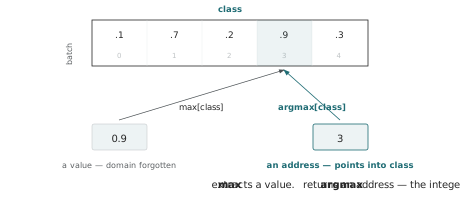
Look at the figure. What does max return? What does argmax return? Before reading on: one returns a value extracted FROM the domain. The other returns an address that points INTO the domain. Which is which, and why does it matter?
max[class] extracts. The result is a scalar—the value 0.9, stripped of its class identity. You could pass that scalar to any function. The fact that it came from class position 3 is forgotten.
argmax[class] returns a pointer. The result is the integer 3—not just any integer, but an address in the class coordinate space. This integer carries a domain contract: the compiler knows it is only meaningful when used to index into a tensor that also carries class.
This contract is enforced. If you write:
let pred[b] = argmax[class](logits[b, class]);
let best[b] = embeddings[pred[b], class];
The compiler checks: does pred[b] carry the class address domain? Yes—it came from argmax[class]. Does embeddings have a class coordinate? Yes—it appears in the indexing expression. Do the domains match? Yes. The indexing is valid.
Now suppose you accidentally write:
let pred[b] = argmax[class](logits[b, class]);
let best[b] = vocabulary[pred[b], token];
The compiler reports:
error: address domain mismatch
  → `pred` carries addresses in domain `class` (from argmax[class] at line 1)
  → `vocabulary` has coordinate `token` at this position
  → expected coordinate `class`, found `token`
  → these domains are different; indexing across domains is not allowed
In PyTorch, this is silent. pred is a tensor of integers. vocabulary[pred] is a tensor of gathered values. Whether pred’s integers refer to class indices or token indices or pixel positions is invisible to the type system. Nothing prevents you from using classification predictions to index into a token embedding table. The bug survives testing until a user passes an out-of-range class index to a token embedding and the program crashes with a cryptic CUDA error, or worse, silently returns garbage.
The address domain contract is what makes argmax conceptually different from max. max says “give me the biggest thing in this set.” argmax says “tell me WHERE the biggest thing is, because I need to go there.” The WHERE is only meaningful relative to the coordinate domain it points into. The compiler tracks which domain that is.
This distinction propagates. If you have:
let top_k[b, k] = topk[class](logits[b, class], 5);
top_k is a tensor of five addresses per batch element, each an address in class. You can use it to index into any tensor that carries class. The compiler knows. The reader knows. The contract travels with the value.
Selection reductions—argmax, argmin, topk—are the only operations that produce address-typed values. Their results are not interchangeable with plain integers. They are typed by the coordinate domain they reference. This is the domain contract from Chapter 2, applied to the concept of “where” instead of “what.”
Four Normalizations
Here are four normalization implementations. Read them. Find what they share.
LayerNorm:
def layer_norm(x, gamma, beta, eps=1e-5):
    mean = x.mean(dim=-1, keepdim=True)
    var = ((x - mean) ** 2).mean(dim=-1, keepdim=True)
    return (x - mean) / (var + eps).sqrt() * gamma + beta
RMSNorm:
def rms_norm(x, gamma, eps=1e-5):
    rms = (x ** 2).mean(dim=-1, keepdim=True).sqrt()
    return x / (rms + eps) * gamma
GroupNorm:
def group_norm(x, num_groups, gamma, beta, eps=1e-5):
    N, C, H, W = x.shape
    x = x.reshape(N, num_groups, C // num_groups, H, W)
    mean = x.mean(dim=(2, 3, 4), keepdim=True)
    var = x.var(dim=(2, 3, 4), keepdim=True)
    x = (x - mean) / (var + eps).sqrt()
    return x.reshape(N, C, H, W) * gamma + beta
InstanceNorm:
def instance_norm(x, gamma, beta, eps=1e-5):
    N, C, H, W = x.shape
    mean = x.mean(dim=(2, 3), keepdim=True)
    var = x.var(dim=(2, 3), keepdim=True)
    return (x - mean) / (var + eps).sqrt() * gamma + beta
Look at the code. The common structure is visible across all four functions. Can you see the specific sequence of operations they all perform? What varies between them?
Here is what they share:
- Compute a statistic (mean, rms, or both) by reducing over one or more dimensions.
- Broadcast the statistic back over the reduced dimensions (via
keepdim=True). - Apply the statistic elementwise (subtract and divide).
- Scale and shift with learned parameters that broadcast over the non-feature dimensions.
Every one of these functions does: reduce, broadcast, elementwise, scale. The difference is only which dimensions are reduced and which parameters broadcast over which remaining dimensions.
But look at the code again. Can you see the shared structure? In LayerNorm, it’s x.mean(dim=-1, keepdim=True). In GroupNorm, it’s x.mean(dim=(2,3,4), keepdim=True). In InstanceNorm, it’s x.mean(dim=(2,3), keepdim=True). The dim arguments are different integers. The keepdim=True flag is the same. The * gamma + beta ending is the same.
The pattern IS there—but it’s encoded as shape arithmetic. This shared structure is a skeleton: a reduce-broadcast-elementwise-scale template parameterized by which coordinates are reduced and which are preserved. dim=-1 means one thing in LayerNorm (“the last dimension”) and a completely different set of integers in GroupNorm (“dimensions 2, 3, and 4”). The skeleton is visible to a human who understands the dimension layout. It is invisible to a compiler. And it changes when the layout changes.
Now here is the same skeleton in Einlang:
| Function | Reduction coords | Broadcast params | Survivors |
|---|---|---|---|
| Softmax | q (max), k (sum) |
none | ..b, j |
| LayerNorm | f (mean ×2) |
gamma[f], beta[f] |
..b, f |
| RMSNorm | f (mean) |
gamma[f] |
..b, f |
| GroupNorm | c_in_group, ..s |
gamma[g, c_in_group], beta[g, c_in_group] |
..b, g, c_in_group, ..s |
| InstanceNorm | ..s |
gamma[c], beta[c] |
..b, c, ..s |
The skeleton is visible in the table because the coordinates are named. Each column says what, not where. The reduction column names the consumed coordinates. The broadcast column names the parameters and their coordinate sets—the difference between the output set and the parameter set is the broadcast claim. This is coordinate set subtraction from Chapter 2, applied to four functions at once. The survivors column names what’s left.
You might wonder: how does the compiler know that mean[f] reduces over f and not over ..b? The answer is that f is a named coordinate — the bracket says mean[f], not mean[..b]. Packs can appear in reduction brackets too (mean[..s]), but the compiler resolves them to concrete coordinates the same way it resolves them in signatures: from the anchor. The reduction bracket is coordinate flow. The pack is a group. The group resolves to its members. The reduction consumes them all.
Here is the same pattern drawn instead of tabulated:
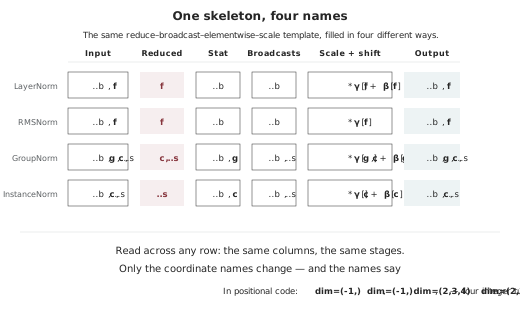
Read across any row: the five columns are the same. The coordinate names change. That is the skeleton.
In a positional API, all four collapse to a single dim argument whose meaning shifts with the surrounding layout. LayerNorm and RMSNorm both use dim=-1—but normalize different statistics. GroupNorm uses three reduction dimensions buried in a reshape chain. The skeleton is invisible.
In a named-coordinate API, the skeleton is a template you can check. The reduction bracket names the consumed coordinates. The indexing pattern names the survivors. The broadcast parameters name the omission. A reviewer can verify that the broadcast coordinate in LayerNorm matches the broadcast coordinate in the gradient without reconstructing both from positional offsets.
This is abstraction: recognizing a pattern, naming it, and reusing it. The pattern is “normalize with named coordinates.” Each instance fills in the specific coordinates. The skeleton is constant.
The discovery exercise—comparing four implementations, finding their shared structure—is what you do every time you read unfamiliar tensor code. Names carry the structure. Positions hide it.
Derive it yourself: Spot the broadcast set. Take the LayerNorm row from the table above. The output has {..b, f}. gamma[f] has {f}. What is the broadcast set for gamma? Compute it: {..b, f} \ {f} = {..b}. gamma broadcasts over every batch dimension. Now take GroupNorm. gamma[g, c_in_group] has {g, c_in_group}. The output has {..b, g, c_in_group, ..s}. Broadcast set: {..b, ..s}. gamma is silent on batch and spatial—exactly as intended. Try the same for InstanceNorm: what does beta[c] broadcast over? The answer is in the set subtraction. The table above tells you the answer if you’re stuck. But do the subtraction yourself first. The subtraction is the check.
Now let’s put this claim to the test. Here is a real GroupNorm implementation in PyTorch:
def group_norm(x, num_groups, gamma, beta, eps=1e-5):
    N, C, H, W = x.shape
    x = x.reshape(N, num_groups, C // num_groups, H, W)
    mean = x.mean(dim=(2, 3, 4), keepdim=True)
    var = x.var(dim=(2, 3, 4), keepdim=True)
    x = (x - mean) / (var + eps).sqrt()
    x = x.reshape(N, C, H, W)
    return x * gamma + beta
Stop and read this carefully. Ask yourself: which dimensions are being reduced by dim=(2, 3, 4)? What do positions 2, 3, and 4 correspond to? You need to trace backward through the reshape—position 2 is C // num_groups (channels per group), position 3 is H, position 4 is W. But this reasoning depends on the reshape chain. If the reshape changes, the dim tuple must change with it. If someone adds a temporal dimension before the spatial ones, the tuple shifts silently.
Now compare the Einlang version:
fn group_norm[g, c_in_group, ..s](x: [f32; ..b, g, c_in_group, ..s],
    gamma: [f32; g, c_in_group], beta: [f32; g, c_in_group])
    -> [f32; ..b, g, c_in_group, ..s]
{
    let m[..b, g] = mean[c_in_group, ..s](x[..b, g, c_in_group, ..s]);
    let v[..b, g] = mean[c_in_group, ..s](
        (x[..b, g, c_in_group, ..s] - m[..b, g]) ** 2.0
    );
    let y[..b, g, c_in_group, ..s] =
        (x[..b, g, c_in_group, ..s] - m[..b, g])
        / (v[..b, g] + 1e-5) ** 0.5;
    y[..b, g, c_in_group, ..s] * gamma[g, c_in_group] + beta[g, c_in_group]
}
The reduced coordinates are named: c_in_group and ..s. No reshape needed. No positional arithmetic needed. If a temporal dimension is added, ..s absorbs it—the reduction bracket stays the same. If num_groups changes, the coordinate g handles it—its domain just has a different size.
The deeper point: in a positional API, “feature” is dim=-1—the last axis. That works when the tensor is 2D. When it becomes 4D, “feature” no longer fits in a single integer. It spans three positions: channels per group, height, width. Positional code handles this with a reshape-permute-reshape dance that groups and ungroups those dimensions. Named coordinates handle it without the dance: one semantic coordinate (c_in_group) plus a spatial pack (..s) cover what dim=(2,3,4) covers in the positional version. The names don’t change when the layout changes.
This is what packs buy you. ..s absorbs however many spatial dimensions exist. The same GroupNorm skeleton works whether spatial covers one axis or three. mean[c_in_group, ..s] says exactly what is consumed—no reshape chain to reverse-engineer.
Now one more question. Suppose you encounter a new normalization variant—say, normalize only over the spatial dimensions, keeping the channel-group dimension intact. What would you change?
Think about it. In the Einlang version, you change one thing: remove c_in_group from the reduction bracket. mean[..s](...) instead of mean[c_in_group, ..s](...). The skeleton is unchanged. The coordinate names carry the design decision.
In the PyTorch version, you’d change dim=(2, 3, 4) to dim=(3, 4)—but only if the reshape hasn’t changed the position of the spatial dimensions. If someone added a temporal axis between c_in_group and H, the tuple would need to shift to dim=(4, 5). The fragility is not in the concept—it is in the notation’s inability to record which dimensions are spatial.
Skeletons Compose
The normalization skeleton and the attention skeleton compose. A Transformer block is LayerNorm, then attention, then another LayerNorm, then a feedforward. In a positional implementation, the norm dimensions and attention dimensions share the dim=-1 convention—until one of them shouldn’t.
Before reading the code, ask: which coordinates does a Transformer block consume and reconstruct? The answer should be visible in the function signature alone.
Here is a complete Transformer block skeleton in Einlang:
fn transformer_block[head, seq, d, d_ff](
    x: [f32; ..b, seq, d],
    W_q: [f32; head, d, d_k],
    W_k: [f32; head, d, d_k],
    W_v: [f32; head, d, d_v],
    W_o: [f32; head, d_v, d],
    W_1: [f32; d, d_ff],
    W_2: [f32; d_ff, d],
    gamma1: [f32; d], beta1: [f32; d],
    gamma2: [f32; d], beta2: [f32; d]
) -> [f32; ..b, seq, d]
{
    // LayerNorm 1
    let norm1[..b, seq, d] = layer_norm[d](x[..b, seq, d], gamma1[d], beta1[d]);

    // Multi-head attention
    let attn_out[..b, seq, d] = attention[head, seq, seq, d](
        norm1[..b, seq, d], norm1[..b, seq, d], norm1[..b, seq, d],
        W_q[head, d, d_k], W_k[head, d, d_k], W_v[head, d, d_v], W_o[head, d_v, d]
    );

    // Residual connection
    let res1[..b, seq, d] = x[..b, seq, d] + attn_out[..b, seq, d];

    // LayerNorm 2
    let norm2[..b, seq, d] = layer_norm[d](res1[..b, seq, d], gamma2[d], beta2[d]);

    // Feedforward
    let ff[..b, seq, d_ff] = relu(sum[d](norm2[..b, seq, d] * W_1[d, d_ff]));
    let ff_out[..b, seq, d] = sum[d_ff](ff[..b, seq, d_ff] * W_2[d_ff, d]);

    // Residual connection
    res1[..b, seq, d] + ff_out[..b, seq, d]
}
Every coordinate that is consumed is named in a bracket. Every coordinate that survives is named in the output pattern. The d coordinate is consumed in two reductions (layer_norm[d] and attention[..., d]) and reconstructed each time. The head coordinate appears on the attention weights but not on the input x—it splits the feature dimension without changing the data layout.
Now ask: if you wanted to change this to a cross-attention block where queries come from one sequence and keys/values from another, what would you change? In a positional implementation, the code wouldn’t change at all—the same attention(Q, K, V) call works for both. The difference is only in which tensors you pass. In the Einlang version, you’d change the signature: the first norm1 gets coordinate seq_q, the second and third get coordinate seq_k. The code change is a coordinate name swap. The reader sees the architectural decision in the type signature.
Skeletons compose because coordinate contracts compose. The output coordinates of one function become the input coordinates of the next. The compiler traces the flow. You trace the meaning.
Pause here. Look back at the Transformer block on the previous page. Find every bracket. For each one, ask: is this coordinate being consumed, reconstructed, or passed through? The answer tells you whether the line is a reduction (consume), a normalization (consume then reconstruct), or a passthrough (neither). Three categories. The entire block—attention, layer norm, feedforward, residual—is built from them.
Spot the Skeleton
Here are four Einlang function signatures. Three implement normalization variants. One doesn’t. Can you spot the odd one out?
fn A[j](x: [f32; ..b, j]) -> [f32; ..b, j]
fn B[coord](x: [f32; ..b, coord]) -> [f32; ..b]
fn C[f](x: [f32; ..b, f]) -> [f32; ..b, f]
fn D[t](x: [f32; ..b, t]) -> [f32; ..b, t]
Look at the return types and notice the pattern yourself before reading on.
Here is the pattern: Function B is the odd one out. Its return type is [f32; ..b]—the coordinate coord is missing. It was consumed and not reconstructed. Functions A, C, and D all return [f32; ..b, <coordinate>]—the coordinate survives. B is a reduction function (like sum[coord]). A, C, and D are normalization functions that preserve the coordinate.
Now the deeper question: why is this distinction visible in the type signature? Because the skeleton is more than “reduce then broadcast.” The skeleton is “reduce, then broadcast back to reconstruct the consumed coordinate in the output.” A pure reduction consumes and doesn’t reconstruct—the coordinate disappears from the return type. A normalization consumes and reconstructs—the coordinate reappears. The difference between “gone forever” and “gone and returned” is the difference between a reduction and a normalization. The return type records it.
The skeleton is visible in the type signature. The reduction bracket in the body (max[coord], mean[f], sum[j]) tells you what is consumed. The return type tells you whether it was reconstructed. A reader can distinguish a normalization from a reduction without reading the body—the coordinate flow is in the signature.
This is the abstraction layer. The function signature says: “I operate on coordinate j. I preserve j in the output. Everything else passes through.” The body fills in the specific computation. The signature is the contract. The body is the implementation. And the contract is checkable.
Derive InstanceNorm
You’ve seen the table. InstanceNorm normalizes each sample’s each channel independently over the spatial dimensions. In 2D: for each (N, C), compute mean and variance over (H, W). The coordinates it reduces over and the coordinates that survive are visible in the operation’s signature. Which coordinates does it consume? Which survive? What parameters broadcast?
Here is the answer:
fn instance_norm[c, ..s](x: [f32; ..b, c, ..s],
                                gamma: [f32; c],
                                beta: [f32; c])
    -> [f32; ..b, c, ..s]
{
    let m[..b, c] = mean[..s](x[..b, c, ..s]);
    let v[..b, c] = mean[..s]((x[..b, c, ..s] - m[..b, c]) ** 2.0);
    let y[..b, c, ..s] =
        (x[..b, c, ..s] - m[..b, c]) / (v[..b, c] + 1e-5) ** 0.5;
    y[..b, c, ..s] * gamma[c] + beta[c]
}
The reduced coordinates are ..s. The surviving coordinates are ..b, c, and ..s—the spatial coordinates are consumed for the statistics but preserved in the output. The broadcast parameters are gamma[c] and beta[c], which broadcast over ..b and ..s.
Three things to observe:
..sabsorbs however many spatial dimensions there are...sis placed in the reduction bracket because it’s consumed for the statistics...sis kept in the return type because the output is not a scalar—it’s a tensor with spatial dimensions.
These three observations together capture the skeleton. The coordinate names carry the design: mean[..s] says “I am consuming the spatial dimensions.” The return type [f32; ..b, c, ..s] says “the spatial dimensions survive.” The contradiction resolves: ..s is consumed in the reduction but reconstructed in the output—the signature guarantees it.
Now consider: what if InstanceNorm should normalize over c as well? You’d change the reduction bracket to [c, ..s]. One change. The skeleton is the same. The coordinate name carries the design decision.
Coordinate Facts Flow
In PyTorch, a tensor leaves the data loader as (32, 64). By the time it reaches the loss function, it has passed through five layers, three reshapes, and a transpose. The numbers have changed. The identities — batch, feature — were never recorded. They are gone. Every function that receives the tensor must re-discover what the dimensions mean from their positions.
In Einlang, the identities survive. Not because the compiler is clever. Because the rule is brutally simple: coordinates only change when an operation explicitly changes them.
Square a tensor. Coordinates unchanged. Add a constant. Coordinates unchanged. Pass through a pointwise function. Coordinates unchanged. Coordinate facts survive every operation that does not explicitly manipulate them. Reductions consume coordinates. Declarations introduce them. Coordinate-aware function calls thread them through signatures. Everything else — arithmetic, function calls that return tensors, if expressions — preserves them. You declare coordinates once. They propagate from that point forward.
This is stronger than type inference. Type inference says x ** 2.0 has the same type as x. Coordinate flow says it has the same identity as x. The identities are not inferred from runtime shapes — they are propagated from declarations. A PyTorch tensor carries (32, 64) at runtime. It does not carry (batch, channel). The identities are lost the moment the tensor leaves the data loader. In Einlang, they survive every intermediate binding, every arithmetic expression, every function return. The source is the declaration. The flow is forward.
Three cases capture the entire system:
let y = x + 1.0;—yhas the same coordinates asx. Addition doesn’t touch identity.let y = sum[j](x[i, j]);—jis consumed.yhas[i]. Reduction is the only operation that removes a coordinate.let y[i, j] = x[j, i];— same names, swapped positions.yhas[i, j]. This is a transpose. Notx.transpose(0, 1). Notx.permute(1, 0). Justy[i, j] = x[j, i]. The names carry the permutation. No position counting needed.
That’s it. Three cases. Every coordinate flow in every Einlang program reduces to these three. The compiler traces them mechanically. You can trace them by hand. The names are the thread.
Reduction is the only consumer. Declaration is the only producer. Everything else is a pipe. Coordinates flow forward from declaration to consumption. Names are not inferred from runtime shapes. They are propagated from source declarations. A name, once declared, survives every operation that does not explicitly consume it.
Pause here. Open a file you wrote last week—any file with tensor operations. Pick five lines that move data: a reshape, a reduction, a broadcast, a permute, an elementwise operation. For each: which of the three cases applies? Coordinate unchanged? Coordinate consumed? Coordinates swapped?
If the answer is “I can’t tell without printing shapes,” you’ve found a place where a coordinate name would have helped your future self. If you can classify all five, you already think in names—you just haven’t been writing them down. The three cases aren’t the language’s rules. They’re the rules the coordinate structure already follows, whether or not your notation records it. The notation just makes them visible.
Coordinates also have a fourth role: time. A coordinate that doesn’t just sit there, but flows.
The Skeleton Pattern, Seen in Signatures
The four-normalizations table revealed that LayerNorm, RMSNorm, GroupNorm, and InstanceNorm share a skeleton. But how do you discover the skeleton in the first place? Not by reading a table. By writing the functions and noticing what changes.
The skeletons are already visible in these signatures—no body needed, just the coordinate names and reduction brackets:
fn softmax[j](x: [f32; ..b, j]) -> [f32; ..b, j];
fn layer_norm[f](x: [f32; ..b, f], gamma: [f32; f], beta: [f32; f]) -> [f32; ..b, f];
fn instance_norm[..s, c](x: [f32; ..b, c, ..s], gamma: [f32; c], beta: [f32; c]) -> [f32; ..b, c, ..s];
Look at only the signatures. Can you tell which one reduces over which coordinate? In softmax[j], the coordinate parameter j tells you: normalize over j. In layer_norm[f], f tells you: normalize over f. In instance_norm[..s, c], both ..s and c are in the signature—but which one is reduced? The answer depends on which coordinate is placed in the reduction bracket in the body. The signature alone can’t tell you—it can only tell you which coordinates exist. The body tells you which ones are consumed.
Now compare to the positional versions:
def softmax(logits, dim=-1): ...
def layer_norm(x, normalized_shape, ...): ...
def instance_norm(x, ...): ...
The positional signatures tell you even less. softmax has dim—a positional hint. layer_norm has normalized_shape—a shape hint, not a coordinate hint. instance_norm has no hint at all—you must read the body to know which dimensions are reduced.
What is happening when you read these signatures: you are asking “which coordinates are needed for this computation?” The ones in the brackets are the answer. The ones not in the brackets pass through. The signature is the skeleton’s outline.
The next time you write a function that takes a tensor and returns a tensor, write its coordinate signature in a comment before the body. Which coordinates survive? Which are consumed? Which broadcast? If you can’t answer from the code alone, the signature is the place to start.
Discovering a Coordinate Contract
The sections you just read show finished products. layer_norm[f] with its correct skeleton. group_norm[g, c_in_group, ..s] with its correct skeleton. The skeletons are clean. The coordinate choices look obvious.
They were not obvious when first written. The finished signature is the last thing you arrive at, not the first. This section walks through the process. You are going to do the walking.
Start Concrete
Standard LayerNorm computes statistics uniformly over the feature dimension. Weighted LayerNorm relaxes this: each feature position has a learned weight that scales its contribution to the mean and variance.
Here is your first attempt. It compiles.
fn weighted_layer_norm[f](x: [f32; ..b, f],
                           w: [f32; f],
                           gamma: [f32; f],
                           beta: [f32; f])
    -> [f32; ..b, f]
{
    let w_sum[..b] = sum[f](w[f]);
    let mean[..b] = sum[f](x[..b, f] * w[f]) / w_sum[..b];
    let centered[..b, f] = x[..b, f] - mean[..b];
    let var[..b] = sum[f](w[f] * centered[..b, f] ** 2.0) / w_sum[..b];
    let y[..b, f] = centered[..b, f] / (var[..b] + 1e-5) ** 0.5;
    y[..b, f] * gamma[f] + beta[f]
}
Before reading on, look at the contract for w. What coordinate set does w claim? The annotation says w: [f32; f]. That means w has exactly one coordinate: f. The weight cannot depend on batch. The weight cannot depend on a group. The weight is per-feature, period.
This works for standard Weighted LayerNorm. The code compiles. The coordinate flow is clean. You run the five checks from Chapter 3 and every one passes. You commit.
A week later, a colleague asks: “Can I use this for group-weighted normalization? I need the weights to vary per group and per channel-in-group.”
You open the file. You stare at w: [f32; f].
Find the baked-in assumption. Before reading on, write it down.
w: [f32; f] hardcodes the weight’s coordinate set to {f}. The skeleton—weighted mean, weighted variance, normalize, scale—does not require {f}. The skeleton requires only that the weight live in whatever coordinate set the reduction consumes. The assumption was not wrong for the problem you solved. It was wrong for the skeleton.
The colleague’s question did not ask for a new skeleton. It asked the existing skeleton to accept a different weight coordinate set.
Parameterize
Write the contract for the group-weighted version. What changes?
You change the coordinate set of w. Instead of w: [f32; f], you need w: [f32; g, c_in_g]. The reduction bracket changes from sum[f] to sum[c_in_g, ..s]. The parameters gamma and beta also move from {f} to {g, c_in_g}.
Here is the result:
fn group_weighted_norm[g, c_in_g, ..s](
    x: [f32; ..b, g, c_in_g, ..s],
    w: [f32; g, c_in_g],
    gamma: [f32; g, c_in_g],
    beta: [f32; g, c_in_g]
) -> [f32; ..b, g, c_in_g, ..s]
{
    let w_sum[..b, g] = sum[c_in_g, ..s](w[g, c_in_g]);
    let mean[..b, g] = sum[c_in_g, ..s](
        x[..b, g, c_in_g, ..s] * w[g, c_in_g]
    ) / w_sum[..b, g];
    let centered[..b, g, c_in_g, ..s] =
        x[..b, g, c_in_g, ..s] - mean[..b, g];
    let var[..b, g] = sum[c_in_g, ..s](
        w[g, c_in_g] * centered[..b, g, c_in_g, ..s] ** 2.0
    ) / w_sum[..b, g];
    let y[..b, g, c_in_g, ..s] =
        centered[..b, g, c_in_g, ..s] / (var[..b, g] + 1e-5) ** 0.5;
    y[..b, g, c_in_g, ..s] * gamma[g, c_in_g] + beta[g, c_in_g]
}
The skeleton is identical to the first attempt. Compare the two, line by line. The only difference is the coordinate set of w, gamma, and beta, and the corresponding reduction brackets. The computation—weighted sum, centered, variance, normalize—is the same sequence in the same order.
Now compare the two contracts. In the first: w claims {f}. In the second: w claims {g, c_in_g}. The skeleton does not care which set. It cares only that the weight’s coordinate set matches the reduction bracket and that the reduction bracket is a subset of the input’s coordinate set.
Here is the general skeleton:
fn weighted_norm[stat_coords, ..survivors](
    x: [f32; ..b, stat_coords, ..survivors],
    w: [f32; stat_coords],
    gamma: [f32; stat_coords, ..survivors],
    beta: [f32; stat_coords, ..survivors]
) -> [f32; ..b, stat_coords, ..survivors]
stat_coords names the coordinate set the weight lives in and the reduction consumes. ..survivors names additional coordinates that exist in the input and survive in the output—the reduction bracket includes them, and the return type reconstructs them. Standard Weighted LayerNorm: stat_coords = f, ..survivors empty. Group-Weighted LayerNorm: stat_coords = {g, c_in_g}, ..survivors = ..s. One signature, every variant.
The Loop
You started with a concrete contract—w: [f32; f]—that compiled and passed every check. A question from outside the code exposed the assumption you did not notice you made. You parameterized the assumption. The skeleton now covers every weighted normalization variant, present and future.
You did not arrive at the general skeleton by starting general. You arrived by starting concrete, finding the assumption, and widening it. The concrete is not a stepping stone you discard. The concrete is the only way to find the assumption.
This is the design loop:
- Write the concrete version. Make it compile.
- Find the assumption baked into the contract.
- Parameterize it.
- Verify the parameterized version still covers the concrete case.
You just ran it.
What Skeletons Reveal
Softmax, LayerNorm, RMSNorm, GroupNorm, InstanceNorm—five different functions, one skeleton. The skeleton is not limited to normalization. Every operation that follows a reduce-broadcast-elementwise pattern is a skeleton.
Consider the mean(, sum(, or max( calls in your codebase. Each one followed by a broadcast is a reduction-statistic-broadcast pattern. The skeleton is there, whether the code names it or not. When the dim argument is an integer, the question “which coordinate is reduced?” has no answer in the code—the reduction’s identity is a position, and the position depends on layout. If the layout changes—a dimension inserted, a transpose applied—the integer now points at a different coordinate, and the skeleton silently shifts shape.
Consider every * gamma + beta or * scale + shift. It is a broadcast-parameter suffix of a normalization skeleton. Which coordinates do gamma and beta broadcast over? In a positional API, the answer is “all dimensions except the one gamma was defined on,” which requires knowing gamma’s rank and the convention for parameter placement. The broadcast is correct by convention, not by construction.
Any two functions that share a skeleton have Einlang signatures. Even without using Einlang, writing fn name[consumed](x: [..b, consumed]) -> [..b, consumed] as a comment above the function reveals the skeleton. Two functions with matching signatures share a skeleton. Two functions with different signatures serve different purposes and should have different signatures. The comment costs one line of typing. The check costs zero.
A normalization variant that normalizes over batch instead of feature changes layer_norm[f] to layer_norm[batch]. The signature change documents the architectural decision. In a positional API, changing dim=-1 to dim=0 silently shifts the coordinate—and hopes no other code depends on the output shape.
Every skeleton’s forward pass is a reduce-broadcast-elementwise pattern. Every skeleton’s backward pass is the Inversion Rule applied to that pattern. The coordinate names are the thread connecting the two directions.
Skeletons are spatial—they describe which coordinates are reduced and which survive at a single point in the computation graph. But coordinates can also flow through time: coordinates indexed by t, t-1, t+1, carrying a causality constraint that the compiler can check. The skeleton’s forward/backward symmetry extends into a forward/backward recurrence—the Inversion Rule, applied to time.